



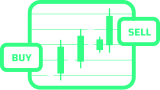
What is Technical Analysis (TA)?
Technical analysis (TA) is a method used by traders to evaluate and predict future price movements based on historical market data, primarily price and volume. Unlike fundamental analysis, which looks at the intrinsic value of an asset, TA focuses on patterns, trends, and market psychology reflected in charts.
Core Concepts
- Price Action Reflects All Information: TA operates on the belief that all known information is already factored into the price, so studying price movement is key.
- Trends Are Your Friend: Prices tend to move in trends — upwards, downwards, or sideways — and identifying these trends helps traders make decisions.
- History Repeats Itself: Market behaviors and price patterns tend to recur due to human psychology.
Tools of Technical Analysis
- Charts: Visual representations of price over time. Common types include line charts, bar charts, and candlestick charts.
- Indicators: Mathematical formulas applied to price and volume data to identify momentum, trend strength, or potential reversals. Examples include Moving Averages, RSI (Relative Strength Index), and MACD (Moving Average Convergence Divergence).
- Patterns: Recognizable formations like head and shoulders, triangles, and double tops/bottoms that suggest future price moves.
How Beginners Can Start
- Learn to read candlestick charts.
- Use simple indicators like moving averages.
- Practice identifying support and resistance levels.
- Combine multiple indicators for confirmation.
- Always use risk management tools like stop-loss orders.
TA is a skill developed over time and is invaluable for making informed trading decisions.
What Are Crypto Derivatives? (Advanced)
Crypto derivatives are financial contracts whose value is derived from an underlying cryptocurrency asset. They allow traders to speculate on price movements without owning the actual crypto, and they provide tools for hedging risk.
Types of Crypto Derivatives
- Futures Contracts: Agreements to buy or sell an asset at a predetermined price on a future date. They can be cash-settled or physically settled.
- Perpetual Swaps: Similar to futures but without expiration dates, allowing traders to hold positions indefinitely, paying periodic funding fees.
- Options Contracts: Give the right, but not obligation, to buy (call) or sell (put) crypto at a set price before expiry.
Benefits
- Leverage: Control larger positions with less capital, amplifying gains and losses.
- Hedging: Protect existing crypto holdings from adverse price movements.
- Speculation: Profit from both rising and falling markets.
Risks
- High volatility can lead to rapid losses.
- Leverage increases risk exposure.
- Requires understanding of contract terms and margin calls.
Crypto derivatives are powerful but complex instruments best suited for experienced traders.
What is Dollar-Cost Averaging (DCA)? (Beginner)
Dollar-Cost Averaging is an investment strategy where you invest a fixed amount of money at regular intervals, regardless of the asset’s price. This approach helps reduce the impact of volatility by averaging the purchase price over time.
Why Use DCA?
- Reduces Timing Risk: Avoids the challenge of trying to buy at the perfect moment.
- Smooths Volatility: Buys more units when prices are low and fewer when prices are high.
- Encourages Discipline: Automates investing, reducing emotional decisions.
How It Works
For example, investing $100 monthly in Bitcoin means you buy more BTC when prices drop and less when prices rise, lowering your average cost per coin over time.
Getting Started
- Decide on a fixed investment amount.
- Choose a regular interval (weekly, monthly).
- Use exchanges or apps that support recurring purchases.
- Stay consistent and avoid reacting to short-term market swings.
DCA is ideal for long-term investors seeking steady portfolio growth.
What is Hedging? (Intermediate)
Hedging is a strategy to reduce potential losses by taking offsetting positions in related assets. In crypto, hedging helps protect your portfolio from market downturns.
Common Hedging Methods
- Short Selling: Borrow and sell crypto expecting to buy it back cheaper.
- Derivatives: Use futures or options to lock in prices or gain downside protection.
- Stablecoins: Convert volatile assets to stablecoins during uncertain times.
- Diversification: Spread investments across different assets to reduce risk.
Benefits
- Protects capital during market drops.
- Provides peace of mind.
- Enables strategic portfolio management.
Risks
- Hedging can limit upside gains.
- Derivatives require knowledge and carry costs.
- Improper hedging can increase risk.
Hedging is a valuable tool when used carefully with a clear strategy.
Crypto Day Trading (Advanced)
Day trading involves buying and selling cryptocurrencies within the same day to profit from short-term price movements.
Key Elements
- Technical Analysis: Use charts and indicators to identify entry and exit points.
- Liquidity: Trade assets with high volume for quick execution.
- Leverage: Amplify positions but be cautious of risks.
- Risk Management: Use stop-loss and take-profit orders to protect capital.
- Discipline: Stick to your strategy and avoid emotional decisions.
Popular Strategies
- Scalping: Multiple small trades for quick profits.
- Range Trading: Buy low, sell high within price ranges.
- Breakout Trading: Enter trades when price breaks support/resistance.
Challenges
- High volatility can cause rapid losses.
- Requires time, focus, and experience.
- Emotional discipline is critical.
Day trading can be profitable but is demanding and risky.
What Are Candlestick Charts? (Beginner)
Candlestick charts display price movements over a set period, showing open, close, high, and low prices.
Components
- Body: The range between open and close prices.
- Green/white body: Means price closed higher (bullish).
- Red/black body: Means price closed lower (bearish).
- Wicks (Shadows): Lines showing the highest and lowest prices during the period.
Common Patterns
- Doji: Indicates market indecision.
- Hammer: Potential bullish reversal.
- Engulfing: Signals trend reversals.
Using Candlesticks
- Identify market sentiment.
- Spot potential reversals and continuations.
- Combine with other indicators for confirmation.